

Copper Cable Theft
Cabling can be cut from panel rows, inverter areas or grid connections, requiring specialist repair and reducing generation.

Solar Farm Security Services
 NASDU
NASDU SafeContractor
 SIA
SIA SafePQQ
 Fully
Fully BS 7858
 ISO 9001
 BS 8517-1
Client feedback repeatedly highlights professionalism, responsiveness and short-notice deployment.

Solar farms often combine remote locations, long fence lines, agricultural access tracks and equipment spread across a large area.
Risk increases after dark, during reduced staffing and throughout construction or commissioning, when natural surveillance may be limited and permanent security measures may be incomplete.
Cameras and perimeter alarms can indicate activity, but distance, blind spots and difficult access can delay physical verification of what has happened.
The resulting impact can include lost generation, specialist repairs, replacement costs, insurance administration and significant management time.
Security incidents can affect valuable infrastructure, project schedules and operational output. These are the principal risks solar farm owners and site managers need to control.
Cabling can be cut from panel rows, inverter areas or grid connections, requiring specialist repair and reducing generation.
Inverters, electrical components, tools and other equipment may be removed from isolated operational areas.
Uninstalled panels, cable drums, plant and materials may be exposed before permanent security measures are fully operational.
Cut fencing, forced gates and damaged access controls can create entry points and vehicle removal routes.
Offenders familiar with the site layout may return after repairs or when replacement cable and equipment arrive.
Damage to panels, connections or supporting infrastructure can reduce output even where no equipment is stolen.

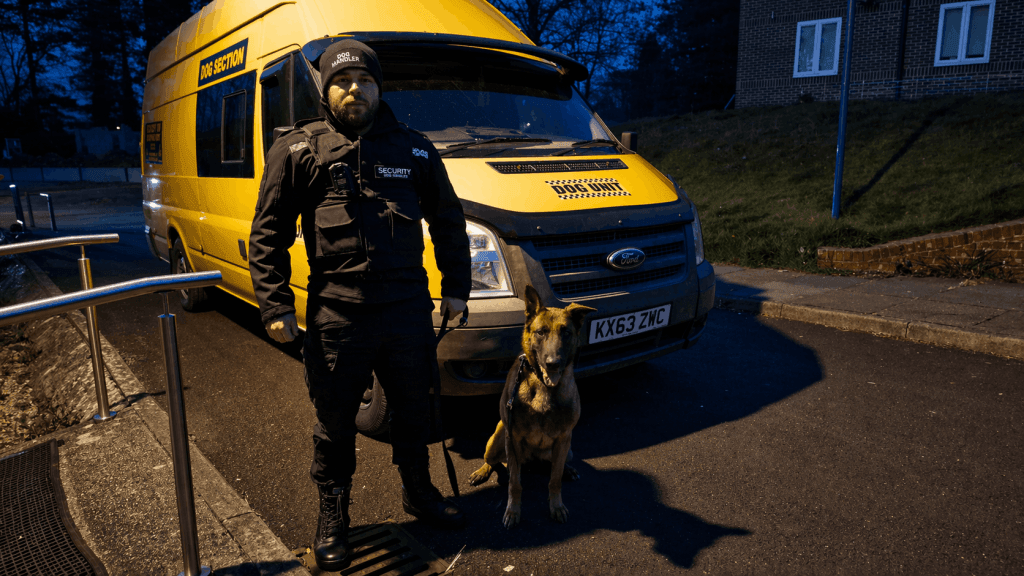
Security dog handlers complement CCTV, alarms and perimeter detection by providing physical verification across authorised areas.
The handler assesses activity and controls the response, while the dog can alert to movement, scent or sound that may not be immediately visible.
Patrols follow approved routes, electrical safety restrictions, site instructions and agreed reporting and escalation procedures.
Checks can cover selected gates, fence lines, access tracks, inverter compounds and other approved priority areas.
The handler can check an agreed area following an alarm or suspicious camera activation.
A visible dog handler team shows that the site remains actively protected outside normal working hours.
Cut fencing, disturbed ground, vehicle tracks and tampered equipment can be identified during patrols.
Relevant locations, observations and damage are documented and reported through the client’s agreed channels.
Suspicious activity is assessed from a safe position before the agreed notification procedure is followed.
Security dog handler cover is most suitable where the site layout, incident history or limitations of remote monitoring create a need for active on-site verification.
The required level of cover should reflect the site size, patrol distances, priority equipment zones and the number of areas requiring regular checks.
Temporary or ongoing cover is required after a theft, attempted theft or confirmed perimeter breach.
New cable or equipment is being installed following an incident and may attract repeat targeting.
Materials and equipment remain on site before permanent monitoring and access controls are fully established.
Remote tracks, long boundaries or equipment areas fall outside effective camera or sensor coverage.
The site needs someone on location who can inspect the relevant area and report what has occurred.
Maintenance, shutdowns, reduced staffing or changes to the site create a short-term increase in exposure.
Solar Farm Cover Built Around Site Risk
Clear patrol priorities, safe working arrangements and reporting responsibilities are established before deployment begins.
Step 1
We review the project phase, layout, required hours, previous incidents and existing security systems.
Step 2
Gates, fence lines, electrical hazards, welfare arrangements, reporting and escalation procedures are agreed.
Step 3
The deployment is matched to the site size, shift pattern, patrol distances and operational instructions.
Step 4
The handler completes agreed checks and communicates alarms, damage or suspicious findings through the client procedure.
If your site has suffered cable theft, a perimeter breach or repeated alarm activations, we can assess temporary or ongoing cover, subject to safe site information and team availability.
Security dog handler cover delivered across commercial, industrial, construction and remote-site environments.
Patrol priorities reflect approved routes, priority assets, existing controls and practical site limitations.
Teams receive recognised dog handler training, including NASDU where applicable.
Operatives hold the relevant SIA licence and are screened in line with BS 7858 requirements.
Deployments account for rest, water, weather conditions, rural terrain and safe working areas.
Client contacts, reporting requirements and escalation responsibilities are agreed before cover begins.
Support is available for individual solar farms, portfolios of sites, temporary incidents and ongoing requirements.
Practical answers about pricing, existing security systems, site safety and deployment.
Pricing depends on the location, required hours, site size, patrol distances and number of handlers needed. We review the requirement before providing a free, no-obligation quote.
Yes. Dog handler cover can complement existing systems by providing an on-site presence able to inspect agreed areas and report what has occurred.
Yes. Temporary or ongoing cover can support the site following theft, attempted theft, perimeter damage or the arrival of replacement equipment.
Yes, where authorised routes, restricted zones and electrical hazards are clearly identified in the site instructions before deployment.
This depends on the site area, patrol distances, number of priority zones and required frequency of checks. Large or divided sites may require more than one handler.
Yes. Cover can support construction, commissioning, operational sites, maintenance periods and temporary changes in risk.
Yes. Multi-site requirements can be reviewed together, with the hours and level of cover assessed separately for each location.
This depends on the location, required hours, team availability and whether the site information and safe working arrangements are ready.
The dog stays with its trained handler. Patrols are planned around workers, visitors, entrances and public areas. Any concern is reported using the agreed process.